South Carolina Dog Registration Information
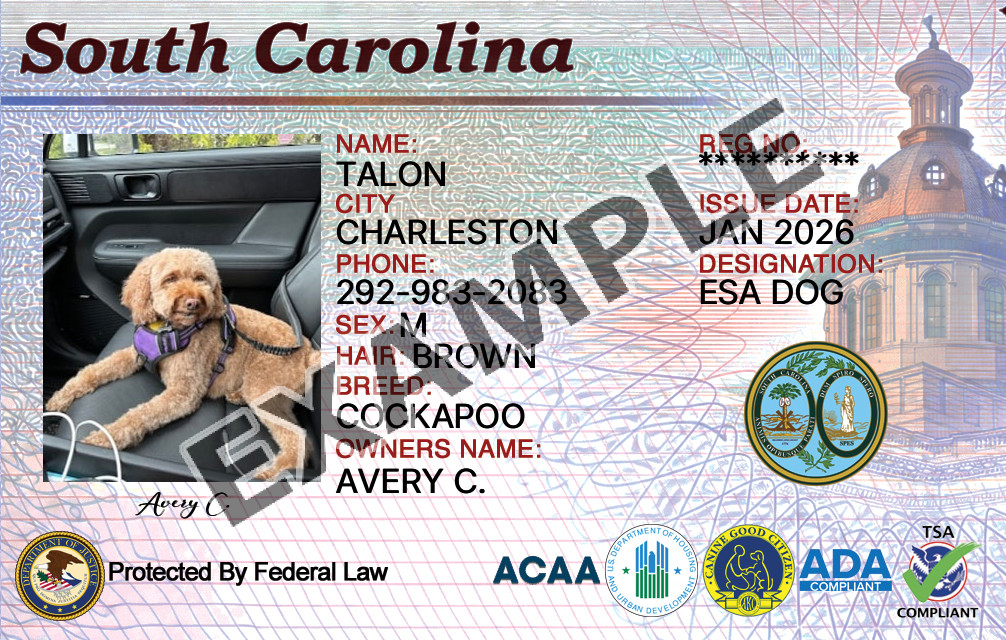
State Licensed, Service Dogs and Emotional Support Dogs in South Carolina
If you are searching for how to register my dog in South Carolina, the most important thing to understand is that dog licensing is usually handled locally. South Carolina does not have one single statewide pet licensing office for every dog owner. Instead, local cities and counties often manage licensing, pet tags, rabies registration, and animal control through their own official agencies. Depending on where you live, that might be a county animal services office, a city animal shelter, an animal control unit, or a local rabies control program.
That local structure is why many owners search for where to register a dog in South Carolina and see different answers depending on the county or city. In some places, the same office handles both licensing and enforcement. In other places, one office handles the pet tag while another handles investigations, bites, strays, and quarantines. South Carolina also ties pet ownership closely to rabies law, so current rabies vaccination records are often required before a local office will issue a tag or complete a registration.
Where to Register or License Your Dog in South Carolina
Because licensing is often handled at the county or city level, the offices below are examples of official South Carolina government offices connected to dog licensing, animal control, pet registration, or rabies enforcement. Your correct office depends on your local jurisdiction.
City of Columbia Animal Services
127 Humane Lane
Columbia, SC 29209
Phone: 803-776-7387
Email: licensemypet@columbiasc.gov
Office Hours: Monday through Friday 12:00 pm to 5:00 pm; Saturday 9:00 am to 4:00 pm; closed Sunday
Orangeburg County Animal Control
1596 Ellis Avenue
Orangeburg, SC 29118
Phone: 803-534-0045
Email: Not publicly listed in plain text on the office page
Office Hours: Monday through Thursday 10:00 am to 4:30 pm
Greenville County Animal Care Services
328 Furman Hall Road
Greenville, SC 29609
Phone: 864-467-3950
Email: lostpet@greenvillecounty.org
Office Hours: Monday through Saturday; full daily hours vary by service
Sumter County Animal Control
1240 Winkles Road
Sumter, SC 29153
Phone: 803-436-2066
Email: Not publicly listed in plain text on the office page
Office Hours: Not clearly listed on the office page; verify before visiting
Beaufort County Animal Services
Beaufort County Animal Services official county program
Beaufort County, SC
Phone: 843-255-5010
Email: Not publicly listed in plain text on the office page
Office Hours: Not clearly listed on the office page; verify before visiting
Memphis and Shelby County Health Department Rabies Program
2480 Central Avenue
This is not in South Carolina and should not be used
Phone: Not applicable
Email: Not applicable
Office Hours: Not applicable
Overview of Dog Licensing in South Carolina
Dog licensing in South Carolina is mostly local
South Carolina dog licensing is largely a local matter. Some cities require all owned dogs and cats to be licensed every year. Some counties issue pet licenses through an animal services department. Other areas focus more on rabies control and identification rather than a formal annual license for every pet. Because local ordinances differ, the answer to where to register a dog in South Carolina depends on the county or municipality where the dog is kept.
Rabies law is a major part of the process
South Carolina rabies law requires owners to keep dogs, cats, and ferrets currently vaccinated. Public health guidance in South Carolina states that pet owners are legally required to keep rabies shots up to date, and local county pages commonly say that dogs must receive their vaccination by 16 weeks of age or by the local deadline used for enforcement. In many places, the rabies certificate is the document that proves your dog is eligible for a tag or local registration. That is why rabies compliance and pet licensing are so closely connected in this state.
Why licensing matters
A dog license in South Carolina can help local agencies identify owned animals, support animal control operations, and improve the chances of returning a lost dog to its owner quickly. Licensing fees may also help support shelter operations, enforcement staff, vaccinations, and community pet programs. In places where a current pet tag is required, it can also reduce confusion if your dog is found loose or becomes involved in a complaint or bite investigation.
Common local agencies involved
The main offices involved usually include county animal services departments, city animal shelters, local animal control units, and in some rabies matters, local health authorities or county environmental health staff. This explains why people searching for animal control dog license South Carolina often see both animal control and rabies-related offices in their results. The exact arrangement depends on the community.
How Dog Licensing Works Locally in South Carolina
Your address determines the right office
The first step in learning how to register my dog in South Carolina is finding the official office that serves your exact address. A dog owner in the City of Columbia will typically work with Columbia Animal Services. Someone in Orangeburg County may deal with Orangeburg County Animal Control. A Greenville County resident may use Greenville County Animal Care Services. The correct office can change even when two homes are only a few miles apart, because city and county boundaries matter.
A typical step by step process
- Make sure your dog has a current rabies vaccination certificate.
- Find the city or county office that serves your residence.
- Complete the local application, renewal, or pet licensing process.
- Provide any required records, usually including proof of rabies vaccination.
- Pay the local fee if your jurisdiction charges one.
- Receive the pet tag, license, or registration record.
- Renew on time according to your local deadline.
Some places require annual licenses
Not every South Carolina jurisdiction uses the same structure, but many do require an annual pet license or current rabies-based registration. For example, Columbia requires city residents to license owned dogs and cats annually. Richland County ordinances also include county pet licensing rules for pets over a certain age. Other counties emphasize registration, rabies tags, and enforcement through their own ordinances. This is why you should not assume that one county’s rules automatically apply statewide.
Rabies enforcement and bite reporting
Rabies enforcement is not just about paperwork. South Carolina public health rules require owners to keep pets vaccinated, and local governments frequently handle bite reports, quarantines, and dangerous animal enforcement through animal control or animal services. If your dog bites someone, is bitten by a potentially rabid animal, or is involved in a quarantine situation, local officials may need to verify vaccination records and ownership quickly. Keeping licensing and rabies records current can make that process much easier.
What if your county focuses more on rabies than licensing
In some parts of South Carolina, residents may hear more about rabies tags, vaccination requirements, and bite enforcement than about an annual dog license. Even in those places, the practical rule is the same: use the official local office that handles pet regulation where you live. Whether the local rule calls it licensing, registration, or rabies compliance, the local agency is the proper starting point for pet ownership questions.
Service Dog Laws in South Carolina
A dog license is not service dog legal status
One of the biggest points of confusion for owners is the difference between a local pet license and service dog rights. A South Carolina pet license is a local government requirement tied to animal ownership, identification, and rabies compliance. Service dog legal status comes from disability law and the dog’s task-based training for a person with a disability. Getting a regular pet tag does not make a dog a service animal.
What makes a dog a service dog
Under federal disability law, a service dog is generally a dog that has been individually trained to perform work or tasks directly related to a person’s disability. The legal focus is on disability-related training, not on a city pet registration or an online certificate. A county pet license shows compliance with local pet rules. It does not prove or create service dog status.
Local compliance may still apply to service dogs
Even a legitimate service dog may still need to comply with ordinary public health rules such as rabies vaccination and local pet licensing requirements that apply generally to dogs in the community. That is because service dog law and pet licensing address different legal issues. One governs disability access rights. The other governs animal regulation and public safety.
Emotional Support Animal Rules in South Carolina
Emotional support animals are different from dog licenses
An emotional support animal is not the same thing as a local dog license. If your animal is a dog and your county or city requires local registration or licensing, you generally still need a dog license in South Carolina even if the dog provides emotional support. Local licensing is about ownership, community safety, and rabies compliance. ESA status usually matters in housing or accommodation settings instead.
Emotional support animals are also different from service dogs
Emotional support animals do not have the same broad public access rights as trained service dogs under the ADA. A service dog is defined by task-based disability training. An emotional support animal may provide comfort, but that does not automatically create the same legal status in restaurants, stores, offices, or other public places. This distinction matters because some owners assume assistance-related paperwork changes local licensing rules. In most cases, it does not.
Housing issues are separate from local pet licensing
Most ESA-related legal questions arise in housing. A landlord or housing provider may need to consider accommodation requests in some situations, but that does not replace the ordinary local licensing or rabies rules that apply to dogs in the area. So if your main goal is finding where to register a dog in South Carolina, your answer is still the official local animal services or animal control office serving your residence.
Frequently Asked Questions
Do I register my dog with the State of South Carolina?
No. In most cases, dog licensing or pet registration is handled by a local county or city office, not one single statewide pet registry.
What office should I contact first?
Start with your local county animal services office, city animal shelter, animal control unit, or rabies-related pet licensing office based on your address.
Do I need proof of rabies vaccination?
Usually yes. Many South Carolina local offices require current rabies vaccination proof before issuing a pet tag or completing a registration.
At what age does my dog need rabies vaccination?
South Carolina public health guidance and county pages commonly indicate that dogs must be vaccinated by the legally required age, often described locally as 16 weeks. Owners should confirm the exact timing with their veterinarian and local office.
Is a dog license the same as service dog registration?
No. A dog license is a local pet regulation issue. Service dog status depends on disability law and task training.
Does an emotional support animal still need a dog license?
Usually yes, if the animal is a dog and the local community requires licensing or registration.
Why do some counties mention animal control and others mention rabies control?
Because South Carolina communities organize pet regulation differently. In some places, animal services handles everything. In others, rabies compliance and public health functions are emphasized more clearly.
What happens if I move to a different county or city?
Your licensing authority may change. You should contact the official local office in your new jurisdiction and ask whether your dog must be re-registered, renewed, or licensed under the new local rules.
What You May Need
- rabies vaccination proof
- identification
- proof of residency
- licensing fee
Quick South Carolina Licensing Notes
Most licensing is handled locally.
Animal services or animal control often manages the tag or registration.
Rabies proof is commonly required.
Rules and renewal deadlines can vary by county or city.
Disclaimer
Licensing requirements and office locations may change. Residents should verify details with their local animal services office within South Carolina.
Register A Dog In Other South Carolina Counties
Select your county from the dropdown below to get started with your dog’s ID card. Requirements and license designs may vary by county, so choose your location to see the correct options and complete your pup’s registration.
- Abbeville Dog License Cards
- Aiken Dog License Cards
- Allendale Dog License Cards
- Anderson Dog License Cards
- Bamberg Dog License Cards
- Barnwell Dog License Cards
- Beaufort Dog License Cards
- Berkeley Dog License Cards
- Calhoun Dog License Cards
- Charleston Dog License Cards
- Cherokee Dog License Cards
- Chester Dog License Cards
- Chesterfield Dog License Cards
- Clarendon Dog License Cards
- Colleton Dog License Cards
- Darlington Dog License Cards
- Dillon Dog License Cards
- Dorchester Dog License Cards
- Edgefield Dog License Cards
- Fairfield Dog License Cards
- Florence Dog License Cards
- Georgetown Dog License Cards
- Greenville Dog License Cards
- Greenwood Dog License Cards
- Hampton Dog License Cards
- Horry Dog License Cards
- Jasper Dog License Cards
- Kershaw Dog License Cards
- Lancaster Dog License Cards
- Laurens Dog License Cards
- Lee Dog License Cards
- Lexington Dog License Cards
- Marion Dog License Cards
- Marlboro Dog License Cards
- McCormick Dog License Cards
- Newberry Dog License Cards
- Oconee Dog License Cards
- Orangeburg Dog License Cards
- Pickens Dog License Cards
- Richland Dog License Cards
- Saluda Dog License Cards
- Spartanburg Dog License Cards
- Sumter Dog License Cards
- Union Dog License Cards
- Williamsburg Dog License Cards
- York Dog License Cards
